By Brad Cordova

Oil & gas companies are operating in increasingly lean environments. Pressures from commodity volatility, ESG targets, and a changing energy landscape mean one thing: every investment must deliver measurable value. In this climate, finding hidden operational inefficiencies can unlock significant returns.
One often-overlooked area of opportunity? Document processing.
From contracts, land agreements, and permits to vendor invoices and compliance reports, the energy industry relies on documentation at every level. And while operations may be high-tech in the field, back-office workflows are often manual, fragmented, and error-prone,creating unnecessary cost and risk.
That’s where AI-powered Intelligent Document Processing (IDP) comes in.
Traditional document processing in oil & gas is typically slow, repetitive, and people-heavy. This creates:
All of these drain productivity—and profits.
AI-driven IDP automates the capture, classification, extraction, validation, and routing of documents—structured and unstructured—without the need for templates or fixed formats.
Whether you're processing:
AI can handle any document—instantly and accurately.
Think your process is working fine for you? Let’s break down the real ROI.
AI eliminates up to 85–95% of manual document work.
This frees up staff, reduces burnout, and prevents the need to scale teams with volume.
AI automates approvals and routing, cutting days or weeks off document lifecycles.
For example:
Humans are imperfect. AI systems validate extracted data, reducing errors in payment processing, compliance filings, or contract terms. This improves audit readiness and reduces costly mistakes.
With searchable, traceable documents and built-in logic checks, compliance becomes proactive—not reactive.
Standardized, structured data allows for real-time reporting, forecasting, and visibility into operations.
Each use case saves time and reduces operational or financial risk.
To determine your potential return on investment:
Example: If you process 3,000 invoices/month manually at $10 each, switching to AI could cut your cost to ~$2/invoice and reduce monthly labor by $24,000—adding up to nearly $300,000/year in savings.
Multiply that across multiple workflows (contracts, reports, audits), and you’re looking at high-impact value.
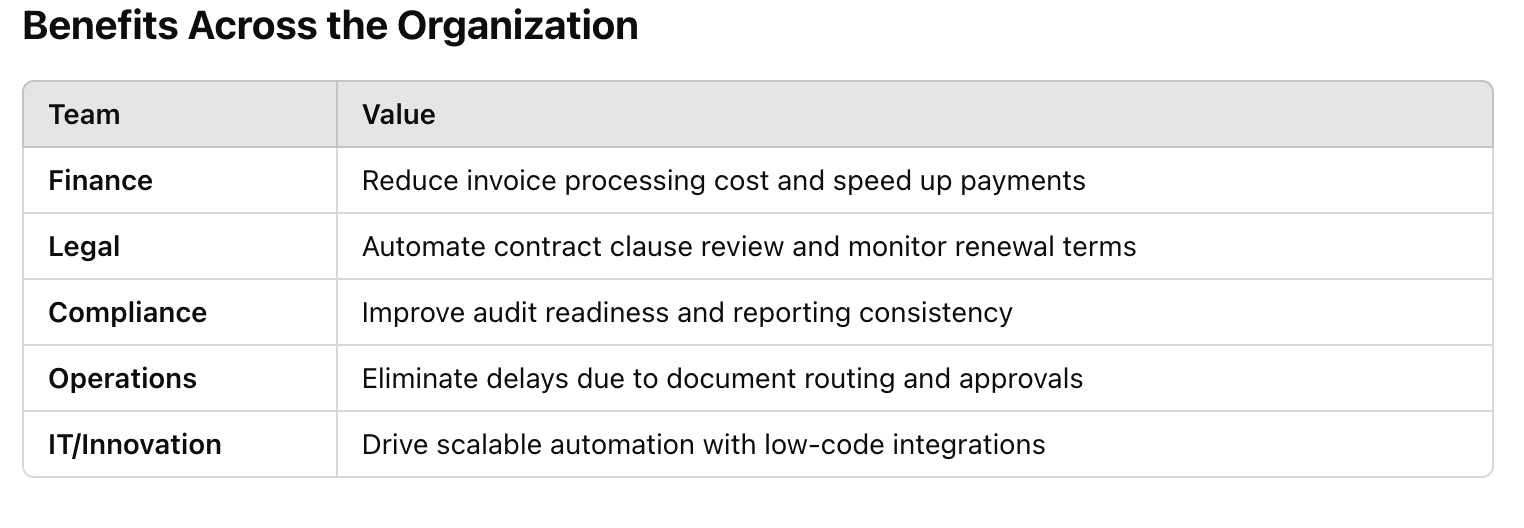
C-suite leaders want to see not just “faster” processes, but quantifiable impact. AI-powered IDP delivers:
It's not just a tool—it’s an operational efficiency engine.
Question: What is AI-powered intelligent document processing (IDP) and how does it work?
Short answer: IDP uses AI to automatically capture, classify, extract, validate, and route information from both structured and unstructured documents—without relying on templates or fixed formats. For oil & gas, this covers land agreements, vendor contracts, field safety reports, environmental permits, and vendor invoices. The system standardizes data and moves it through approvals, cutting out manual keying and handoffs that slow teams down.
Question: Where does the ROI come from—and how big can it be?
Short answer: ROI is driven by labor reduction, faster cycle times, higher accuracy, stronger compliance, and data visibility for better decisions. Typical impacts include eliminating 85–95% of manual document work, processing contracts 60–70% faster, and moving invoices from received to paid in hours. Example: processing 3,000 invoices/month manually at $10 each drops to about $2/invoice with AI, reducing monthly labor by ~$24,000—nearly $300,000/year. Multiplying these savings across contracts, reports, and audits compounds the value.
Question: Which workflows deliver the fastest payback in oil & gas?
Short answer: High-ROI starters include:
Question: How does IDP improve accuracy and compliance?
Short answer: AI validates extracted data and applies logic checks to catch errors before they propagate into payments, filings, or contracts. Documents become searchable and traceable, enabling proactive compliance and stronger audit readiness. Standardized, structured data also supports consistent reporting and faster responses to regulatory inquiries.
Question: How do we estimate ROI and make the business case to leadership?
Short answer: Start by quantifying your current workload and costs:

You’re not just automating paperwork—you’re reclaiming time, reducing costs, and making your entire business more agile.
Whether your goal is to scale without scaling headcount, reduce compliance risk, or speed up decision-making, AI document processing delivers.

Most invoice problems aren't processing problems — they're capture problems. Learn what invoice data capture is, where it breaks down, and how AI fixes it.

Manual document processing costs more than most teams realize. Learn what document process automation is, how it works, and what to look for in a platform.