By Emily Wigdale
Everyone’s shouting about what AI can do. I sat down with Brad Cordova, Co-Founder & CEO of super.AI, to explore the question nobody else seems to be asking: what does AI give back and why might the most powerful thing about artificial intelligence be how deeply, profoundly human it makes us.
By Emily Wigdale · Marketing, super.AI
“The paradox is that AI makes the human more human. It doesn’t replace jobs it replaces tasks. And that changes everything.” - Brad Cordova, Founder of super.AI
I’ve been thinking a lot about the noise. Open LinkedIn on any given morning and you’ll find the same breathless headlines: AI will replace your job. Automate everything. If you’re not using AI, you’re already behind. It’s loud, it’s urgent, and after sitting down with Brad Cordova, I think it’s almost entirely missing the point.
Brad has been building in the AI space since 2012, long before it was fashionable, back when half of every sales call was spent explaining what machine learning even was. He’s watched the market swing from deep skepticism to all-out mania. And what struck me most in our conversation was this: the companies treating AI as a replacement for humans are asking the wrong question entirely.
The right question isn’t what can AI do instead of people? It’s what does AI make possible for people?
Brad was candid about this. “There is real power in AI,” he told me. “We’ve built our entire company on it. But right now, the market is in the grip of a kind of collective mania where every problem looks like it needs an AI solution, and every AI solution looks like a miracle.” He laughed. “We’ve spent the last few years having to temper expectations almost as much as we used to have to spark them.”
Here’s what the hype misses: AI is a tool. A remarkable, genuinely transformational tool but a tool nonetheless. Just like software. Just like the people on your team. Each has strengths. Each has limits. Using them well means understanding which is which.
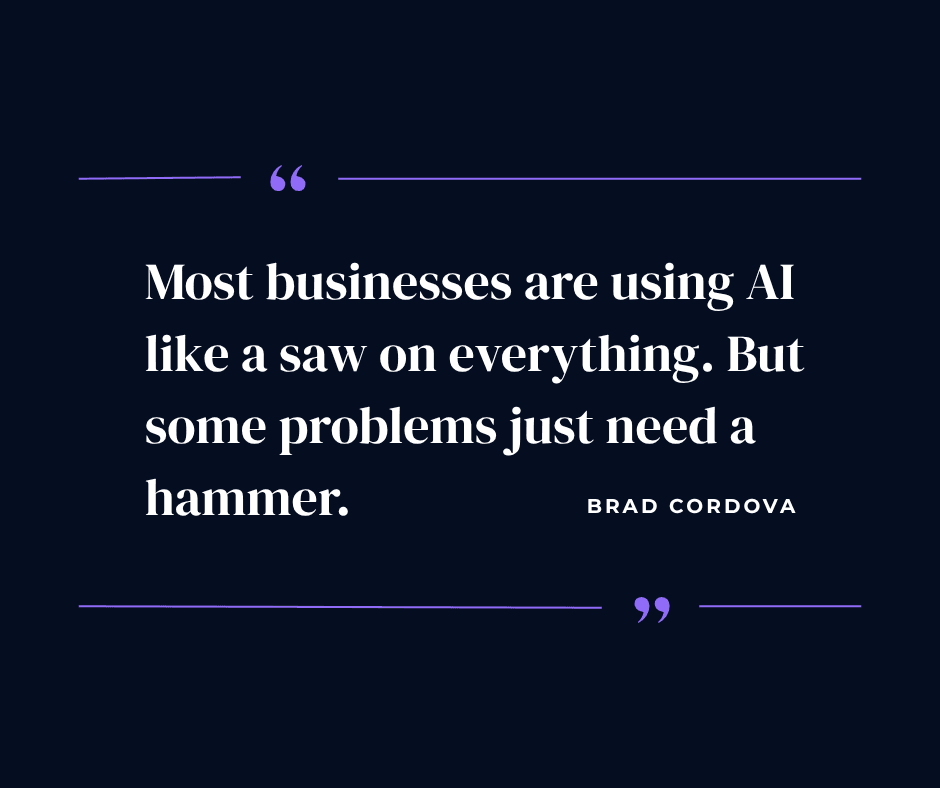
“You wouldn’t use a hammer to saw a piece of wood, and you wouldn’t use a saw to hammer a nail. Right now, a lot of businesses are doing exactly that with AI swinging it at everything and wondering why the results feel off.” — Brad Cordova
It’s an analogy that stuck with me. Software is reliable, deterministic, auditable, perfect for stable workflows where the steps are known. AI is dynamic, able to navigate unpredictable or constantly shifting tasks. And humans? We’re creative, empathetic, and irreplaceable in the moments that actually matter. The magic, Brad told me, happens when you stop asking which tool to use and start asking which tool belongs where.
Software: Reliable, deterministic workflows. Stable guardrails at scale. Ideal when the steps are known.
AI: Dynamic, adaptive, and able to handle the unpredictable. Best when the path can’t be pre-defined.
Humans: Creativity, judgment, and trust. Irreplaceable for the work that actually requires a person.
This is where the conversation got personal for me. Think about the work that drains your team. The invoices that arrive handwritten, in a dozen formats, from a hundred different vendors. The contracts that need to be cross-referenced against a database before anyone can act on them. The endless cycle of extracting information from one system, verifying it against another, and routing it to a third. Work that is, at its core, mechanical but that falls on human shoulders because nobody built the bridge between the systems.
That’s exactly what super.AI was built to automate. Not the judgment calls. Not the conversations that require empathy or creative problem-solving. The rote, repetitive, soul-compressing work that keeps talented people trapped in a loop they didn’t sign up for.
The result isn’t fewer jobs. It’s better ones. When the mechanical work disappears, what’s left is the work that humans are actually great at and, not coincidentally, the work that people find meaningful. Brad put it simply: “That’s not a soft benefit. It changes productivity, retention, and culture in ways that pure efficiency metrics struggle to capture.”
I asked Brad to take me back to the beginning. super.AI didn’t start as a document automation company it started as a conviction. Before founding the company, Brad was building AI at True Motion, where his team had to construct almost everything from scratch: training clusters, inference pipelines, data labeling infrastructure. The tooling simply didn’t exist.
“We could see, years before ChatGPT, that large-scale AI models were going to arrive,” he said. “And we made a deliberate choice: instead of trying to out-compete the companies pouring billions into model development, we would go deep on the layer of the stack they were ignoring. We would become specialists.”
They chose documents. Not glamorous, Brad was the first to admit it, but documents are everywhere. Enterprises are drowning in unstructured data that machines struggle to read, and the tools that existed were brittle, template-based, and inaccurate. super.AI built something better. And when customers started asking for more, automate everything around the extraction, not just the extraction itself, they built that too.
Today, the platform handles the full lifecycle: ingesting documents from email, ERPs, or cloud storage; classifying and extracting the data inside; verifying it against external systems; routing exceptions to a human reviewer when real judgment is needed; and pushing the result downstream, automatically. As Brad put it: “The human in that loop isn’t a workaround. They’re the point.”
What I took away from this conversation was a refreshing counternarrative to everything flooding my feed. The AI companies that win long-term won’t be the ones that screamed loudest about replacement. They’ll be the ones that understood the actual opportunity: to give people back their time, their attention, and their dignity at work.
super.AI isn’t interested in fear as a sales tactic. They’re not here to tell you that you’re already behind, or that you’ll be obsolete by next quarter. They’re making a different case that AI, used well, is one of the most human things a company can invest in.
Because when the rote work disappears, what remains is the work only people can do. And that’s where your team was always meant to be.
“The goal has never been to remove the human from the process. The goal is to return the human to the most human parts of it.” — Brad Cordova
That’s the super.AI philosophy. And after spending an hour with Brad, I’m convinced it’s the most important conversation the AI industry isn’t having.
We’d love to have it with you.

Most invoice problems aren't processing problems — they're capture problems. Learn what invoice data capture is, where it breaks down, and how AI fixes it.

Manual document processing costs more than most teams realize. Learn what document process automation is, how it works, and what to look for in a platform.